
Many patients come to me with the same question: can something be done about a denture that keeps causing problems? The denture shifts, falls out while eating, makes it impossible to eat hard foods, and causes embarrassment in social situations. The question of replacing a denture with fixed teeth on implants is therefore entirely justified. However, to make an informed decision, it is worth understanding how the two solutions differ — not only in terms of comfort, but also in their effect on bone, durability, and cost.
Removable dentures — how they work and what limits them
A complete removable denture is a restoration that rests on the mucosa of the alveolar ridge. Its stability depends on the suction created between the denture plate and the mucosa (for the upper jaw) and on the shape of the ridge and the tension of the lip and cheek muscles (for the lower jaw). There is no mechanical anchoring in the bone.
In practice, this means several persistent limitations: the denture may shift during chewing of hard foods, speaking, or yawning. With a lower denture, the problem is more pronounced — the mandibular ridge is smaller and resorbs faster, which over the years makes it increasingly difficult to keep the denture in place. The use of denture adhesives or regular relining and replacement of the denture (typically every few years) is necessary.
There is also an important issue that patients are often unaware of when choosing a denture: a removable denture does not stop the resorption of the alveolar ridge bone. The lack of mechanical loading on the bone leads to its gradual resorption. As the bone resorbs, the shape of the ridge changes, causing the denture to fit progressively worse — and the cycle continues.
However, a removable denture is an effective solution, less expensive upfront, and sometimes the only realistic option — for example, in patients with serious contraindications to surgery or with extreme bone loss where other methods are impossible or unjustified. It is not a bad solution — it is different, and it has its justified applications.
Fixed teeth on implants — how All-on-4 and All-on-6 work
The All-on-4 and All-on-6 methods involve permanently anchoring a prosthetic restoration in the bone using four or six titanium implants. The implants are placed under anesthesia, and in most cases the patient leaves with a fixed, temporary prosthesis on the same day — cemented or screwed in, removable only by the dentist.
From the patient's perspective, the result is fundamentally different from a removable denture: the restoration does not move, you can bite hard foods, it requires no adhesives, and it does not need to be taken out at night. After osseointegration is complete (approximately 4-6 months), the final prosthetic work is made — usually from zirconia — intended as a long-term solution for many years.
Implants also serve a biological function: they transmit chewing forces to the bone, which prevents further resorption. The bone is mechanically stimulated — similar to natural teeth — and retains its volume better than with a removable denture.
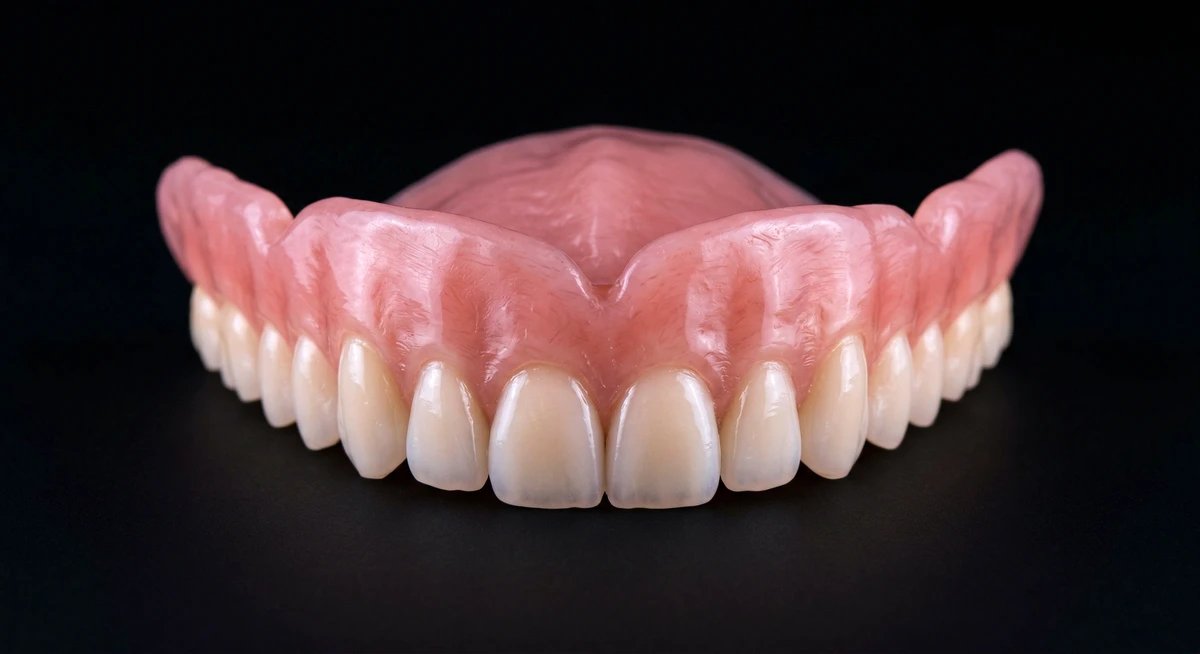
Removable denture
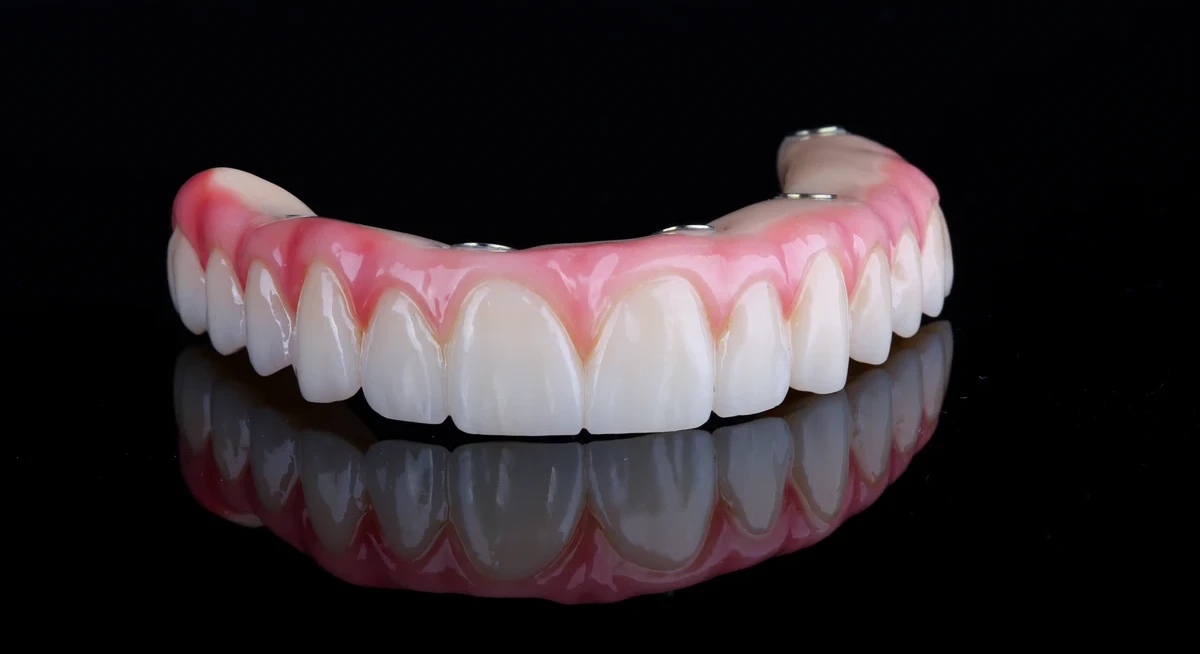
Implant-supported bridge (All-on-6)
| Aspect | Removable denture | Fixed teeth on implants (All-on-4 / All-on-6) |
|---|---|---|
| Stability | Depends on ridge shape and suction; decreases over the years | Permanent, anchored in bone; does not change with age |
| Palate | Covered by the denture plate — affects taste and sensations while eating | Uncovered — natural taste and thermal sensations |
| Gum pressure | Denture rests on gums — pressure causes gradual bone loss | No pressure — load is transferred through implants directly to the bone |
| Eating and speaking comfort | Limited — may shift during eating and speaking | Similar to natural teeth; full stability |
| Wearing comfort | Often a "foreign body" sensation, discomfort, gag reflex | Full stability like natural teeth — no discomfort |
| Removal | Daily removal, cleaning, reinsertion | No need to remove — fixed, screwed onto implants |
| Alveolar bone loss | Progressive — denture does not transfer loads to the bone | Halted or significantly slowed — implants stimulate the bone |
| Restoration durability | Typically replaced every few years due to ridge resorption | Titanium implants — decades with proper hygiene; prosthetic work — 10-20 years |
| Appearance | Good, but the denture plate may be visible with full lips or when smiling | Natural, no visible plate; precise dental aesthetics possible |
| Initial cost | Lower — a few thousand zlotys | Higher — detailed pricing: All-on-4 pricing |
| Long-term cost | Regular costs for relining, replacement, adhesives; can be significant over the years | Higher one-time cost, but lower ongoing costs over the years |
Who are implants recommended for
Full-arch implant reconstruction is recommended primarily when:
- the removable denture is unstable and significantly impairs the patient's quality of life
- the patient wants a permanent solution without the need for daily removal and reinsertion of the denture
- preserving alveolar bone and preventing further loss is a priority
- the patient's general health permits a surgical procedure (local or general anesthesia)
- the quantity and quality of alveolar bone is sufficient — or can be augmented using bone grafting techniques or zygomatic implants
Age alone is not a contraindication. I perform full-arch reconstructions for patients of various ages, including those over 70 and 80, provided their general health permits it.
When a removable denture is sufficient
Not every patient needs to or wants to opt for implant treatment. A removable denture is a justified and effective solution in the following situations:
- the patient does not experience significant problems with their current denture and is satisfied with it
- general health precludes surgical procedures (coagulation disorders, severe systemic diseases, active oncological treatment)
- advanced bone loss rules out standard implantation and the patient does not want or cannot use alternative methods
- the patient does not accept the time, cost, or scope of implant treatment — and this is a fully justified decision
The role of the dentist is not to convince the patient to choose implants — but to present the options honestly, their differences and long-term consequences, so that the decision is an informed one.
All-on-4 and All-on-6 — how the procedure works
Full-arch reconstruction pricing
Smile in one day — what the surgery day looks like
Frequently asked questions
Can I replace my removable denture with implants?
In most cases, yes. The prerequisite is sufficient alveolar bone or the possibility of augmenting it through bone grafting, sinus lift, or the use of zygomatic implants in cases of advanced bone loss. Qualification is based on a clinical examination and CBCT scan.
How much does it cost to replace a denture with implants?
The cost of full-arch implant reconstruction depends on the number of implants, the type of prosthetic restoration, and whether prior bone augmentation is needed. Detailed information is available on the All-on-4 pricing page. A precise estimate is provided after consultation and CBCT analysis.
Is the implant procedure painful?
The procedure is performed under local or general anesthesia and is not painful in itself. After the procedure, swelling and moderate discomfort may occur for a few days, managed with pain medications. Most patients describe post-operative discomfort as significantly milder than they had expected before the procedure.
How long does the treatment take when replacing a denture with fixed teeth?
With the immediate loading protocol (All-on-4 or All-on-6), the patient leaves with fixed temporary teeth on the day of the procedure. The final prosthetic restoration is made after osseointegration is complete — approximately 4-6 months later. If prior bone augmentation is required, the total treatment time is extended accordingly.
With immediate implant loading, the patient receives fixed teeth on the day of surgery — without the need to wear a removable denture during the transitional period.