
- In Poznań, at the Elite Smile clinic (ul. Selerowa 1), I perform full-arch reconstructions only — a fixed bridge on implants screwed onto 4 or 6 implants (All-on-4, All-on-6).
- Patients call this treatment different names — implant dentures, a fixed bridge on implants or teeth on implants. In a full-arch reconstruction they usually mean the same thing: a fixed, screw-retained bridge you do not remove.
- The procedure can be performed under general anaesthesia: with an anaesthesiologist present, you sleep through the entire treatment. The temporary bridge is screwed in the same day.
- For severe bone loss I use zygomatic and pterygoid implants — often without bone grafting or a sinus lift, in a single surgery.
- Consultation and a large-field CBCT scan are done on site. The prosthetic part is led by Dr Klara Muszyńska, DDS, and appointments are arranged by patient coordinator Mateusz Osypiuk. Prices are set by the clinic — Elite Smile price list (in Polish).
Updated:
Full-arch implants replace a removable denture — or failing teeth — with a fixed bridge screwed onto several implants. In Poznań I provide this treatment at the Elite Smile clinic, especially for patients with severe bone loss and for those who prefer to sleep through the procedure under general anaesthesia.
Fixed teeth on implants in Poznań — what it is and who it is for
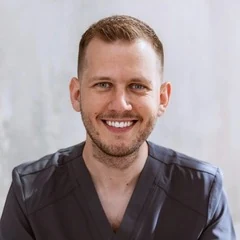
Dr Paweł Sawicki, PhD — maxillofacial surgeon. I have been practising implant dentistry for over 12 years and have performed more than 4,000 implant procedures — from single implants to full-arch reconstructions with zygomatic and pterygoid implants. In Poznań I operate at the Elite Smile clinic, ul. Selerowa 1. More about me →
A full-arch bridge is a complete row of teeth screwed onto 4 implants (All-on-4) or 6 implants (All-on-6). You do not remove it, it needs no adhesive and in the upper jaw it leaves the palate free. You clean it much like your own teeth — with a toothbrush and super floss; a water flosser is optional but helps many patients (details below). Implants transfer chewing forces to the bone, which limits further bone loss.
- you wear a removable denture and are tired of it moving, adhesives and sore spots,
- your remaining teeth are failing and you want to replace them with fixed teeth in one procedure,
- you have been told you do not have enough bone for implants,
- you have postponed treatment for years because of severe dental anxiety.
More on the method: All-on-4 and All-on-6 and dentures vs implants.
Treatment under general anaesthesia — you sleep through it
At Elite Smile, implant surgery and fitting of the fixed bridge can be performed under general anaesthesia. You fall asleep before the procedure and wake up when it is over — no sounds, smells or vibrations. For extensive treatment, when remaining teeth are extracted and 4–6 implants placed in one session, it allows everything to be done in a single visit.
Who benefits most
- severe dental anxiety (dental phobia),
- extensive treatment — extractions and implants in both jaws in one visit,
- zygomatic and pterygoid implants — longer procedures for severe bone loss,
- a strong gag reflex that makes treatment under local anaesthesia difficult.
Safety
- an anaesthesiologist and an anaesthesia nurse are present throughout,
- hospital-grade anaesthesia machine and patient monitor — the same class as in operating theatres,
- continuous monitoring of ECG, oxygen saturation, blood pressure and breathing (including exhaled CO₂),
- a recovery room with monitoring until you are fully awake.
Preparation
- Anaesthesia assessment — detailed medical history (conditions, medication, allergies), basic blood tests and an ECG; the scope is set individually depending on your health. You receive the detailed list after the consultation and qualification for treatment. The CBCT scan, clinical examination and photographs are needed to plan the full-arch reconstruction — not for the anaesthesia itself.
- Fasting — no food for 6 hours and no drinks for 4 hours before surgery.
- A companion — after anaesthesia you go home with an adult; no driving for 24 hours.
Your general health matters a great deal. Unstable heart disease or an acute respiratory infection must be stabilised first — they can rule out not only general anaesthesia but even surgery under local anaesthesia. That is why every patient has a detailed medical interview, and the surgery date is set once your health allows it.
Severe bone loss — zygomatic and pterygoid implants instead of bone grafts
After years without teeth or with a removable denture, the upper jaw loses bone — especially at the back, under the maxillary sinuses. The classic approach is bone grafting or a sinus lift, months of healing and only then implants. As a maxillofacial surgeon I often use bone that does not resorb:
| Solution | Where the implant is anchored | When |
|---|---|---|
| Zygomatic implants | Cheekbone (zygoma) — implants 30–52 mm long | Very severe bone loss in the upper jaw |
| Pterygoid implants | Back of the upper jaw and the pterygoid process — implants usually about 15–20 mm long | No bone at the back of the upper jaw — instead of a sinus lift |
| Tilted implants (All-on-4) | Bone in front of the sinuses and in the lower jaw | Moderate bone loss |
The result: one surgery and a temporary bridge the same day instead of two or three procedures spread over a year. More: implants with bone loss.
Teeth in one day — the bridge is made in the clinic
- after implant placement, a photogrammetry scanner records the implant positions with an accuracy of about 10 microns, so the bridge fits without stress on the implants,
- the bridge is designed digitally and 3D-printed in the clinic, then individually painted — about one hour including curing,
- the bridge is screwed onto the implants the same day.
The final bridge — composite on a milled titanium bar or zirconia — is made after 4–6 months, once the implants have integrated with the bone.
Treatment step by step
- Consultation and large-field CBCT scan covering both jaws and the sinuses; you receive a written treatment plan with costs broken down by stage.
- Tests before anaesthesia — if you choose general anaesthesia: basic blood tests and an ECG according to the list you receive after the consultation.
- Surgery day — extractions, implant placement (including zygomatic or pterygoid implants), scan and fitting of the temporary bridge.
- Check-up after 7–10 days.
- Healing (osseointegration) — about 3 months on a soft diet.
- Final bridge after 4–6 months.
- Follow-up — every 6 months at first, then once a year, with professional cleaning of the bridge.
Before and after surgery: All-on-4 recovery.
Caring for a bridge on implants — keeping implants healthy for years
You clean the bridge in your mouth, much like your own teeth. The routine I recommend:
- Toothbrush twice a day with a low-abrasive toothpaste — brushing the bridge and gums like natural teeth.
- Super floss twice a day — threaded under the bridge to clean the part that rests on the gum.
- Water flosser — optional. It helps many patients, but it is not used with zygomatic implants: with a misdirected nozzle, pressurised fluid could enter the maxillary sinus. Other cleaning methods are used with these implants.
- Check-ups and professional cleaning — every 6 months at first, then once a year.
The final bridge usually fits the gum very closely, so food rarely gets underneath and it does not affect daily life. Extra cleaning with super floss nevertheless keeps the implants and gums in very good condition for many years. Brushing and flossing twice a day give very good hygiene and significantly reduce the risk of inflammation around implants (peri-implantitis) — the main cause of late implant problems.
The team in Poznań
| Who | Role |
|---|---|
| Dr Paweł Sawicki, DDS, PhD | Maxillofacial surgeon — assessment, planning and surgery, including zygomatic and pterygoid implants |
| Dr Klara Muszyńska, DDS | Prosthodontics — temporary and final bridge, bite, follow-up |
| Anaesthesiologist with an anaesthesia nurse | General anaesthesia and patient safety during surgery |
| Mateusz Osypiuk | Patient coordinator — appointments, pre-anaesthesia tests, travel arrangements |
I have performed more than 4,000 implant procedures; full-arch reconstructions with zygomatic and pterygoid implants are the main part of my practice. I also run implant courses for dentists. More: about me.
Cost in Poznań
Treatment prices in Poznań are set by Elite Smile — see the Elite Smile price list (in Polish). After the consultation you receive a written treatment plan with costs broken down by stage. Payment in instalments is available. Questions about cost and payment: +48 792 570 474, elitesmile.pl.
Patient case — Mr Marcin, both jaws in one procedure under general anaesthesia
Mr Marcin came with advanced root caries and multiple missing teeth — the remaining teeth could not be predictably saved. Because of severe dental anxiety, the entire surgical part was performed under general anaesthesia.
| Mr Marcin's case | |
|---|---|
| Upper jaw | Fixed bridge on 6 implants, including 2 pterygoid implants — no bone graft, no sinus lift |
| Lower jaw | Fixed All-on-4 bridge on 4 implants, the 2 back ones tilted |
| Scope | All teeth extracted and 10 implants placed in one procedure |
| Anaesthesia | General anaesthesia |
| Temporary teeth | Fixed bridges screwed in on the day of surgery |
| Final bridges | Zirconia, after about 6 months of healing |
| Team | Surgery: Dr Paweł Sawicki · prosthodontics: Dr Klara Muszyńska · coordination: Mateusz Osypiuk |
Healing was uneventful, with typical swelling and little pain. Full case description: Elite Smile case study (in Polish).
Mr Marcin: How did I end up here? By chance. My wife called this clinic — she was looking. We were going to a wedding and she really wanted me to… Well, I said we wouldn't go unless I had teeth. I mean, I wouldn't go, because I was ashamed. I had 4 teeth at the bottom, you can see it in the photos. I left here… Oh my, happy. It was done under general anaesthesia.
Question: How much did the option of general anaesthesia influence your decision?
Mr Marcin: I wanted it from the start. Yes, all along I wanted it under general anaesthesia. I don't know, somehow as a kid I had a trauma. Dentists were what they were back then. After the anaesthesia I came round very quickly. I sat for maybe another 2 hours, because I was waiting for the lower denture. The upper one was made earlier, after some fittings, and the lower one was made on site, on the day of the surgery.
Mr Marcin: I'm more open now. I can smile, I go out everywhere. Now I want to go everywhere, and before I avoided everything. And the wedding? It was wow. Everyone: wow. As far as I remember, I hadn't had teeth for about 13 years. I think it's the best thing for me.
Getting to Elite Smile in Poznań
Elite Smile, ul. Selerowa 1, Poznań
The map is loaded from Google — once shown, Google may set cookies.
- Address: Elite Smile, ul. Selerowa 1, 61-314 Poznań, Poland
- Phone: +48 792 570 474, e-mail: [email protected]
- Opening hours: Monday–Saturday 8:00–20:00
- From Poznań Ławica airport (POZ): about 30–35 minutes by car
- From Poznań Główny station: about 20 minutes by car
- By car: easy access from the A2 motorway (Berlin–Warsaw)
Other clinics: contact.
Frequently asked questions
Can dental implants be placed under general anaesthesia?
Yes. At Elite Smile in Poznań, implant placement and fitting of a fixed full-arch bridge can be done under general anaesthesia. An anaesthesiologist and an anaesthesia nurse are present throughout, and vital signs are monitored continuously. General anaesthesia itself requires a detailed medical history, basic blood tests and an ECG — the scope of tests is set individually, depending on your health and chronic conditions; you receive the detailed list after the consultation and qualification for treatment. A CBCT scan is not needed for the anaesthesia — it is needed to plan the full-arch reconstruction.
Can I get fixed teeth with severe bone loss?
In most cases, yes. When the upper jaw lacks bone, zygomatic implants are anchored in the cheekbone and pterygoid implants in the back of the upper jaw and the pterygoid process. This often avoids bone grafting and a sinus lift, and the temporary bridge can still be fitted the same day. Eligibility is decided on the CBCT scan.
Will I leave with teeth on the same day?
Yes, provided the implants achieve sufficient stability — which is the case in the vast majority of patients. The implant positions are scanned after surgery and the temporary bridge is printed in the clinic, so it is screwed in the same day. According to clinic data, in August 2026 every full-arch patient left Elite Smile with a fixed bridge.
How long does the procedure take?
For both jaws, surgery takes about 3 hours, and making the bridges and screwing them onto the implants takes another 2–3 hours. For one jaw, surgery takes about 1.5–2 hours. After general anaesthesia you stay in the recovery room until fully awake and go home the same day with a companion. Do not drive for 24 hours.
How much does it cost in Poznań?
Treatment prices in Poznań are set by Elite Smile — see the Elite Smile price list; after the consultation with a CBCT scan you receive a written treatment plan with costs broken down by stage. General anaesthesia is charged separately. Payment in instalments is available.
Who performs the treatment?
Surgery — implant placement, including zygomatic and pterygoid implants — is performed by Dr Paweł Sawicki, DDS, PhD, maxillofacial surgeon. The prosthetic part is led by Dr Klara Muszyńska, DDS. Anaesthesia is provided by an anaesthesiologist. Appointments and logistics are arranged by patient coordinator Mateusz Osypiuk.
How do I care for a fixed bridge on implants?
Twice a day: a toothbrush with low-abrasive toothpaste and super floss threaded under the bridge to clean the part that rests on the gum. This routine gives very good hygiene and significantly reduces the risk of inflammation around the implants. A water flosser is optional — it is not used with zygomatic implants, because with a misdirected nozzle pressurised fluid could enter the maxillary sinus. Add regular check-ups with professional cleaning of the bridge.
How do I get there from abroad?
Poznań Ławica airport (POZ) is about 30–35 minutes from the clinic by car, with direct flights from the UK, Ireland, Norway, Germany and other European countries. Poznań Główny railway station is about 20 minutes away. Plan to arrive the day before surgery.
This content is for information only. The treatment method, number of implants and suitability for general anaesthesia are decided after a consultation and CBCT scan.